
Purpose
Agentic AI systems move far beyond generating answers: they invoke tools, interact with databases and CRMs, mutate business records, execute multi-step workflows, and coordinate specialized autonomous agents. That creates transformative operational efficiency, but it also introduces operational risks distinct from standard chatbots or content generators.
Production readiness is not simply whether an agent can complete a task during a controlled demo. It is whether the system's actions are reliably bounded, reviewable, measurable, and recoverable when something goes wrong.
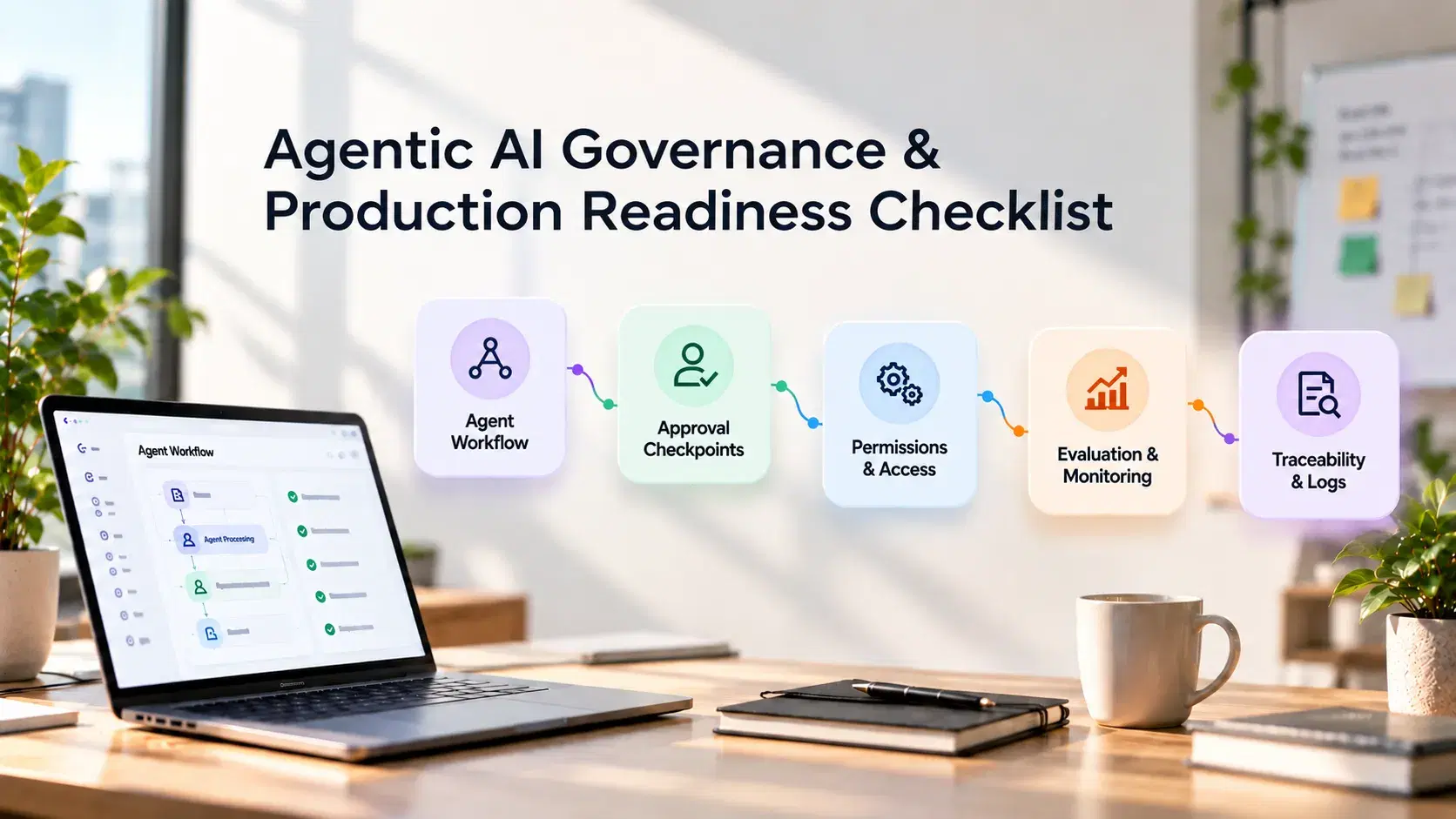
This checklist helps product, engineering, and risk leaders evaluate eight core operational dimensions before an agent is deployed to business workflows. It is a decision framework, not a static certification standard. Control intensity should match workflow sensitivity and the consequences of an unintended action.
Quick Readiness Scorecard
Evaluate each functional dimension against three clear readiness states:
- Not Defined: The team has not yet documented the control, owner, or expected failure behavior.
- Partly Defined: The control exists informally, but automated testing, test coverage, or operational ownership is incomplete.
- Production Ready: The control is formally documented, tested against realistic edge cases, and assigned to a designated operational owner.
High-risk workflows (financial transfers, compliance reports, candidate ratings) require strict controls, while low-risk tasks (retrieving FAQs, drafting summaries) can operate with lighter review gates.
Business Objective & Action Boundaries
The primary governance question is not which foundation model to deploy. It is what actions the agent is permitted to perform autonomously.
Before writing code, product teams must evaluate these foundational questions:
- What specific business outcome is the agent designed to accelerate?
- Is the agent permitted to recommend, draft, query, mutate, execute, or approve transactions?
- Which system operations are explicitly prohibited?
- Which decisions must strictly remain with a human operator?
- What is the agent's behavior when confidence is low or input context is ambiguous?
- Who assumes accountability for business outcomes produced by the agent?
A proven architectural pattern separates low-risk assistance from high-impact execution. For example, an agent can summarize support tickets automatically, while issuing customer refunds or changing user credentials requires human authorization.
Data & Grounding
An autonomous agent is only as dependable as the knowledge it accesses and the rules governing how that data is interpreted.
Teams must define clear data boundaries:
- Which databases, knowledge bases, and API endpoints may the agent query?
- Which data sources take precedence when information conflicts?
- How frequently is the underlying knowledge base updated?
- Is retrieval-grounding mandatory before the agent is permitted to formulate an action?
- How are missing, contradictory, or stale inputs handled?
- Does the system preserve end-to-end source citations for auditability?
- What sensitive data (PII, credentials, proprietary financial records) must be scrubbed before model ingestion?
Grounding reduces hallucinations, but teams must still implement boundary checks to ensure out-of-context data does not trigger unintended actions.
Tool & Permission Controls
Tool execution is the exact boundary where an AI agent transitions from informational reasoning to operational action. Permissions must be engineered with least privilege.
- Which APIs, production databases, and third-party tools can the agent invoke?
- Does each tool have strictly scoped read-only, write, or execute permissions?
- Can permissions be restricted to specific environments and record IDs?
- Are high-risk endpoints isolated behind secondary authorization barriers?
- Where are API keys stored, and what is the automated secret rotation policy?
- Is there strict environment isolation separating sandbox testing from live production?
- Are guardrails in place to prevent unpredictable tool-chaining loops?
For sensitive operations, the safest design pattern is for the agent to prepare a proposed payload and prompt a human operator for approval rather than executing direct state changes.
Human Approval Checkpoints
Human-in-the-loop (HITL) engineering is not about inserting a generic confirmation button. It requires pinpointing where human judgment delivers maximum oversight value.
- Which specific actions require manual authorization prior to execution?
- Who has the role-based authority to grant approval?
- What context (prompts, retrieved sources, predicted confidence) is shown to the reviewer?
- Can the human operator edit, reject, or override recommendations seamlessly?
- Does the system record reviewer identity and timestamped decisions?
- What escalation occurs if a reviewer fails to respond within SLA windows?
- Does the workflow automatically divert anomalies and edge cases to manual review?
Ideal IT Techno implements this across production systems: in the Intelligens multi-agent platform, specialized agents assist with candidate scoring while recruiters retain full override power. In the CleverGens orchestration suite, approval gates govern updates to core business software.
Evaluations & Test Cases
Manual testing with a handful of prompts is insufficient for production agents. Teams require an automated regression test suite to verify stability whenever models, prompts, tools, or business rules update.
- What quantitative criteria define a successful task execution?
- Which edge cases, prompt injections, and API timeouts pose the greatest risk?
- Does the test suite cover standard, adversarial, and boundary scenarios?
- How are tool-selection accuracy and parameter formatting benchmarked?
- Are there definitive pass/fail thresholds blocking flawed releases?
- How does the system validate behavior when upstream foundation models change?
- Who determines whether a minor performance degradation is acceptable for release?
Observability & Audit Trail
When an autonomous agent executes decisions across company systems, engineering and compliance teams need complete forensic visibility into every step.
- Are all intermediate reasoning steps, tool calls, and API inputs/outputs logged?
- Are errors, automatic retries, and blocked operations flagged immediately?
- Can operators inspect the exact context window that drove a specific action?
- Are execution latency, token expenditures, and tool response times tracked in real time?
- Can incident responders reconstruct the chronological action sequence after a bug?
- What is the data retention and redaction policy for sensitive operational logs?
Observability provides the telemetry required to debug agent drift and prove system integrity.
Failure Handling, Escalation & Rollback
Production environments experience failures: APIs time out, models hallucinate invalid parameters, schemas change, and rate limits are reached. Systems must degrade gracefully.
- What happens when a downstream tool call fails or times out?
- Which operations are safe to retry automatically, and which must fail immediately?
- Under what exact criteria does the agent abort a workflow and alert human operators?
- Is there a safe fallback path (such as routing to a human queue) when an agent fails?
- Can high-impact database mutations be rolled back or compensated for?
- How quickly can a misbehaving prompt or model version be reverted in production?
- Who is the designated on-call owner when agent workflows stall?
The golden rule of agentic reliability is explicit failure over silent hallucination. When certainty is lacking, the agent must halt safely rather than guess.
Production Monitoring
Passing pre-release evaluations does not guarantee stability over time. Production monitoring must blend infrastructure telemetry with business workflow KPIs.
- What percentage of started tasks reach successful completion without manual intervention?
- What is the trend for human override and rejection rates?
- Are token costs, model latency, and API error spikes monitored against alerts?
- Is output quality periodically sampled and reviewed by domain experts?
- Can the team detect output drift following third-party LLM provider updates?
- Which concrete business metric (e.g., ticket resolution time, conversion speed) proves value?
Practical Production-Readiness Review
Before deploying any AI agent into live operations, review these eight foundational questions in a cross-functional alignment session:
- Action Boundaries: What actions can the agent execute independently, and which actions are strictly prohibited?
- Grounding & Data: What authoritative data grounds the agent, and how are contradictions handled?
- Tool Permissions: Which tools can the agent access, and are permissions scoped to the absolute minimum?
- Human Checkpoints: Where must human operators approve, inspect, or override decisions?
- Regression Testing: How will we test the workflow before and after prompt or model changes?
- Auditability: Can every tool invocation, failure, and state change be reconstructed from audit logs?
- Failure Handling: What happens when the model, tool, or integration fails?
- Ongoing Value: How will we verify the system remains safe, accurate, and useful after launch?
Production Patterns from Ideal IT Techno Projects
- Intelligens Pattern: Demonstrates that multi-agent pipelines perform best when individual agents have specialized, narrow responsibilities and structured data schemas. Human-in-the-loop review ensures high-stakes decisions remain fully explainable and accountable.
- CleverGens Pattern: Highlights the necessity of end-to-end traceability, role-based tool authorization, and manual escalation queues when orchestrating actions across disparate business systems.
Common Governance Mistakes
- Treating the demo as production readiness: A successful pilot in a controlled sandbox does not test edge cases, rate limits, or failure recovery.
- Granting overly broad API permissions: Giving agents administrative database privileges creates massive vulnerabilities. Scope access tightly.
- Adding human approvals everywhere: Excessive approval requests defeat automation efficiency. Position human checkpoints only at high-consequence junctions.
- Omitting human review completely: High-stakes actions should never execute without human verification.
- Measuring only technical uptime: An agent can return HTTP 200 OK responses while producing incorrect business decisions. Monitor workflow accuracy and override frequencies.
- Treating governance as marketing certification: True governance is an operational discipline built into architecture, not an unsubstantiated compliance badge.
Quick FAQ
What does production-ready Agentic AI mean?
Production readiness means an agent has strictly bounded capabilities, least-privilege tool access, robust error handling, automated regression testing, complete audit logging, appropriate human checkpoints, and continuous monitoring for drift.
Does every AI agent require human approval?
No. Approval intensity should correspond to risk. Low-risk operations like synthesizing documents or searching data can proceed autonomously, while irreversible actions like making payments or updating customer records require human oversight.
How should organizations restrict AI agent tool permissions?
Adopt the principle of least privilege. Grant read-only access where possible, isolate staging from production environments, safeguard secrets in enterprise key vaults, and require explicit approval tokens for state-altering actions.
How do you evaluate an AI agent prior to launch?
Build automated test suites with real-world scenarios, adversarial inputs, and simulated tool failures. Measure parameter validation accuracy, task completion rates, safety boundary compliance, and error recovery behavior.
How should AI agents be monitored post-launch?
Combine technical metrics (latency, error rates, token costs) with business signals (human override percentage, manual intervention rates, and business KPI improvements).
Ready to review your Agentic AI architecture?
Ideal IT Techno partners with enterprise engineering teams to design resilient action boundaries, tool guardrails, human checkpoints, and production observability. Explore our Agentic AI Solutions or learn about our AI Agent Developers.
Speak with an AI Solutions Architect →