Purpose
This guide helps product, technology, and business teams decide whether an AI requirement is better served by an existing product, a custom AI solution, a dedicated AI delivery team, or a hybrid approach. The goal is not to push one model as universally better. The right choice depends on how differentiated the workflow is, how deeply the solution must integrate with existing systems, how much control the business needs, and who will own the product after launch.
The 60-Second Decision Summary
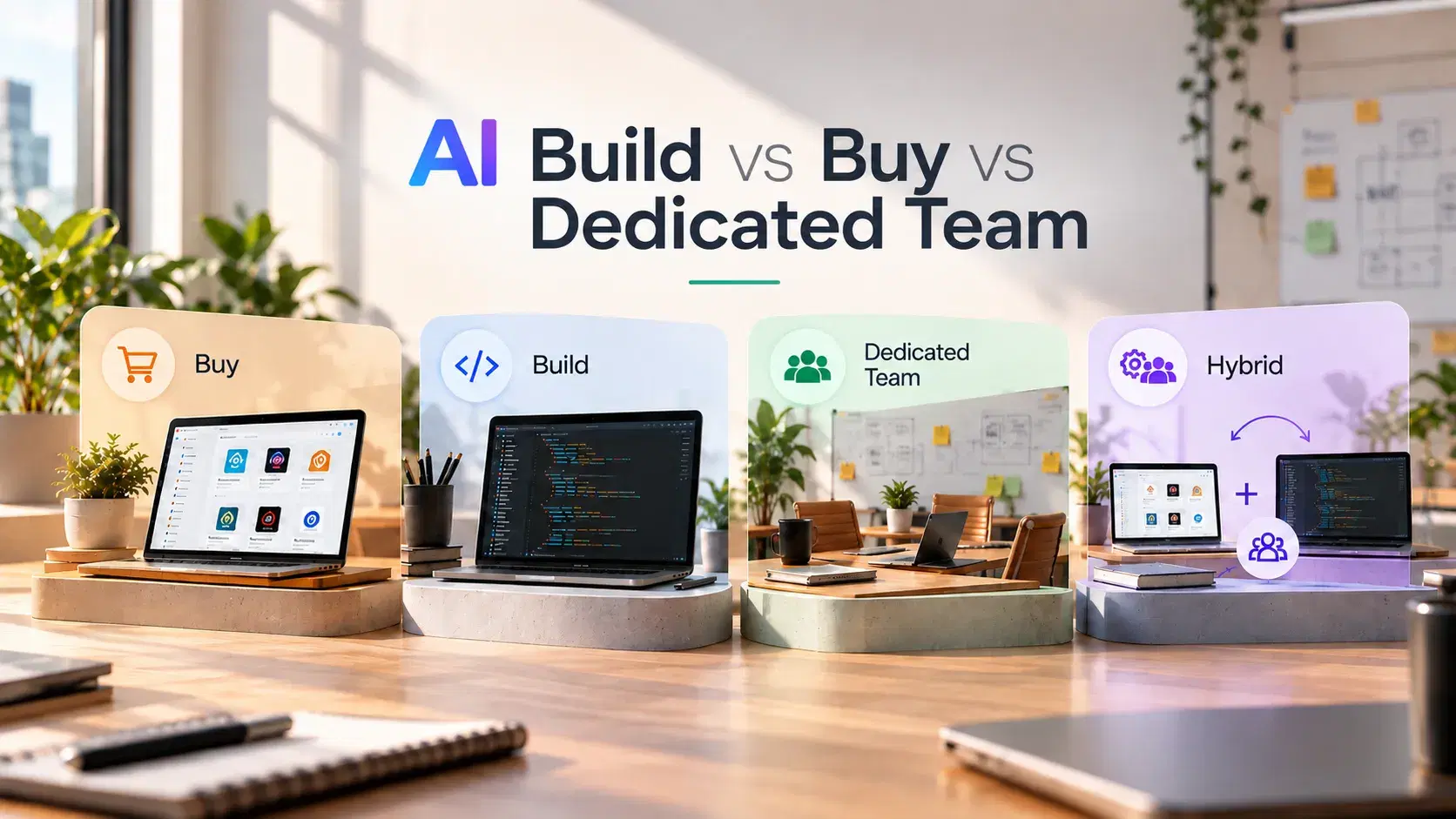
- Buy an off-the-shelf AI product when the use case is already solved well by a mature product, differentiation is low, standard integrations are sufficient, and the priority is to start quickly with limited internal engineering effort.
- Build a custom AI solution when the workflow is strategically important, proprietary data or deep integrations matter, the business needs stronger control over architecture and roadmap, or existing products do not fit the requirement well enough.
- Use a dedicated AI team when the company has an ongoing roadmap rather than one isolated project, expects frequent iteration, or needs sustained engineering capacity that the internal team cannot provide alone.
- Use a hybrid approach when commodity capabilities can come from existing models or platforms, while the differentiated workflow, integration layer, controls, or user experience should remain custom.
Decision Matrix
Compare the four primary delivery paths across key operating criteria:
| Delivery Model | Time to Start | Customization | Integration Depth | Control Level | Best Fit |
|---|---|---|---|---|---|
| Buy / Off-the-Shelf | Usually fastest | Low to medium | Standard APIs & connectors | Lower; vendor roadmap | Common workflows with established tools |
| Build / Custom Solution | Slower (discovery + architecture) | Highest | Deep (proprietary data & core systems) | Highest over logic & stack | Differentiated core workflows & competitive edges |
| Dedicated AI Team | Medium (onboarding & access) | High across initiatives | Deep and ongoing | High alignment to internal roadmap | Continuous roadmaps, multiple AI products |
| Hybrid Approach | Faster than pure scratch build | Medium to high at differentiation layer | APIs + custom workflow logic | Selective control where value lives | Standard foundation + custom IP layer |
- Buy / Off-the-Shelf AI: Ongoing ownership is mostly vendor-led with internal administrative oversight. Main watch-outs: Vendor lock-in, limited workflow flexibility, unexpected pricing changes, data-handling constraints, and feature boundaries outside the product's core scope.
- Build / Custom AI Solution: Ongoing ownership is higher—prompts, models, tools, integrations, and evaluations require active maintenance. Main watch-outs: Underestimating maintenance overhead, vague product ownership, inadequate automated evaluation, and building custom tech where off-the-shelf software is sufficient.
- Dedicated AI Team: Ongoing ownership is continuous shared delivery against your backlog. Main watch-outs: Weak prioritization, treating sheer engineering capacity as business strategy, and insufficient architecture documentation or knowledge transfer.
- Hybrid: Sits between pure buy and custom build. Main watch-outs: Sprawling vendor dependencies, fragmented observability, unclear failure ownership, and hidden reliance chains.
Questions to Ask Before Choosing
- Is the use case already solved well by a mature product? If yes, buying is usually the fastest, lowest-risk path. Custom development should have a clear justification beyond engineering preference.
- Is workflow differentiation strategically important? If the workflow directly drives your competitive advantage, higher control justifies custom or hybrid engineering.
- Are proprietary data or deep integrations required? The more an AI agent relies on private company systems, cross-platform workflows, and historical data, the more critical integration depth becomes.
- How much control is required over architecture, models, prompts, tools, and roadmap? Some teams need only the output; others must audit prompt versions, model providers, tool invocations, and data governance.
- Is there an internal product or technical owner? Adding engineers does not replace decision ownership. Every initiative needs an internal leader to define acceptable behavior, priorities, and business trade-offs.
- Is this a one-time project or an ongoing roadmap? A single isolated need can be satisfied by a fixed-scope build or subscription, while a multi-quarter AI transformation calls for dedicated capacity.
- What human approvals and governance controls are required? Determine which tasks the system may complete autonomously, which require human review, and how critical actions are audited.
- Who owns maintenance after launch? APIs deprecate, model behaviors drift, and business processes evolve. Post-release ownership must be assigned before code is written.
When Buying Is Usually the Better Decision
Buying is often the right choice when speed matters more than differentiation, the workflow is standard across industries, an existing product covers core requirements, and out-of-the-box integrations suffice.
Examples include meeting note-taking, general transcription, baseline email assistance, commodity customer support chatbots, and basic document parsing. Custom development in these categories frequently consumes resources without delivering proportional differentiation.
The trap to avoid is building custom AI simply because AI is strategic. Real enterprise value comes from applying the right technology efficiently, not necessarily from owning every line of code.
When Custom Building Makes More Sense
Custom AI development becomes defensible when the business value is embedded within a unique proprietary process, when multiple enterprise systems must orchestrate harmoniously, when private operational data improves the result, or when full control over operating logic and user experience is mandatory.
Teams embarking on custom builds should address key design criteria upfront:
- Which concrete actions can the system execute independently?
- Which tools, databases, and third-party APIs can it access?
- Where is human sign-off mandatory?
- How will output quality and reasoning latency be benchmarked?
- What are the fallback procedures when an external API or model times out?
Explore our engineering capabilities in AI Development Services and specialized Agentic AI Solutions to design tailored architectures.
When a Dedicated AI Team Is the Better Model
A dedicated team model excels when AI initiatives represent an ongoing program rather than an isolated release. This applies to organizations planning sequential milestones, repeated experimentation, or continuous model refinements across multiple departments.
A dedicated group builds institutional knowledge around your codebase, security requirements, and internal domain context. However, engineering capacity cannot substitute for internal product ownership—your internal team must still guide business priorities.
For organizations needing sustained velocity, review how you can Hire Dedicated AI Developers to scale capacity smoothly.
Why Hybrid Is Often Underrated
Most enterprise software does not need to reinvent underlying foundation models. A hybrid architecture leverages off-the-shelf LLMs, speech engines, or vector databases for baseline capabilities, while keeping data ingestion pipelines, orchestration layers, guardrails, and customer-facing interfaces entirely custom.
This balances rapid time-to-market with complete ownership of your strategic intellectual property and proprietary logic.
Example Patterns from Ideal IT Techno Projects
- Intelligens Multi-Agent Pattern: In candidate evaluation, specialized AI agents handle screening, contextual parsing, and skill scoring. However, recruiters maintain ultimate authority to validate ratings and override recommendations. Multi-step workflows requiring high trust benefit from custom orchestration paired with human checkpoints. See the Intelligens Case Study.
- CleverGens Orchestration Pattern: In data-intensive environments, orchestration layers connect AI agents to existing ERPs and CRMs with audit logging and approval gates. The intelligence lies not in the raw model response, but in verifiable state management and traceable executions. Explore the Clevergence Case Study.
Common Mistakes When Choosing an AI Delivery Model
- Building before defining the workflow: Selecting models or vector databases before establishing the business bottleneck.
- Deciding solely on launch speed: Prioritizing a quick pilot while overlooking long-term vendor lock-in and customization ceilings.
- Ignoring post-launch ownership: Forgetting that prompt evaluations, model updates, and API changes require ongoing maintenance.
- Treating governance as a post-launch add-on: Access permissions, data retention, and audit trails must be designed upfront.
- Assuming an external team replaces internal leadership: Dedicated teams need clear product direction and decisive requirements.
- Over-engineering commodity features: Rebuilding standard functionalities that established SaaS platforms already solve effectively.
Recommended Next Step by Path
- If Buy looks right: Shortlist mature products, test them on actual production samples, audit compliance and security constraints, and conduct a structured pilot.
- If Build looks right: Formalize the target workflow, data boundaries, API access, human-in-the-loop checkpoints, and evaluation metrics before selecting tech stacks.
- If Dedicated Team looks right: Outline the multi-quarter roadmap, identify internal product stakeholders, define required skill sets, and establish documentation standards.
- If Hybrid looks right: Separate commodity infrastructure from proprietary value, then determine where vendor APIs suffice and where custom code creates defensibility.
Ownership, Portability and Reversibility
A comprehensive build-vs-buy decision evaluates what assets your business must own and how reversible the decision is. Buying reduces initial development friction but exposes you to vendor price increases, API deprecations, and restrictive data silos. Custom building offers ultimate autonomy but carries long-term operational responsibility.
Ask before committing: Can prompts, vector embeddings, and workflows be migrated if a model provider changes? What is the switching cost if an external vendor shifts their terms? Designing with reversibility in mind prevents costly technological dead ends.
Quick FAQ
Should a company buy AI software or build a custom AI solution?
Buy when standard commercial software handles the workflow effectively and differentiation is minimal. Build when proprietary workflows, deep internal integrations, custom control, or distinct user experiences generate strategic advantage.
When does a dedicated AI team make more sense than a fixed-scope project?
A dedicated team is ideal when your AI roadmap spans multiple quarters, features evolve rapidly, and your organization has strong product leadership but requires flexible engineering velocity.
Is a hybrid AI approach a compromise?
No. A hybrid approach is often the smartest enterprise strategy: leveraging proven third-party foundation models and vector stores while keeping your data layer, business logic, and security guardrails proprietary.
What should be decided before starting an AI implementation?
Map the underlying business workflow, identify authoritative data sources, set decision boundaries, specify human approval gates, establish automated test benchmarks, and assign post-launch operational owners.
Not sure which path fits your requirement?
Ideal IT Techno helps technology leaders evaluate workflow complexity, integration depth, and team models before committing capital to a custom build or team expansion.
Schedule a Decision Architecture Session →