
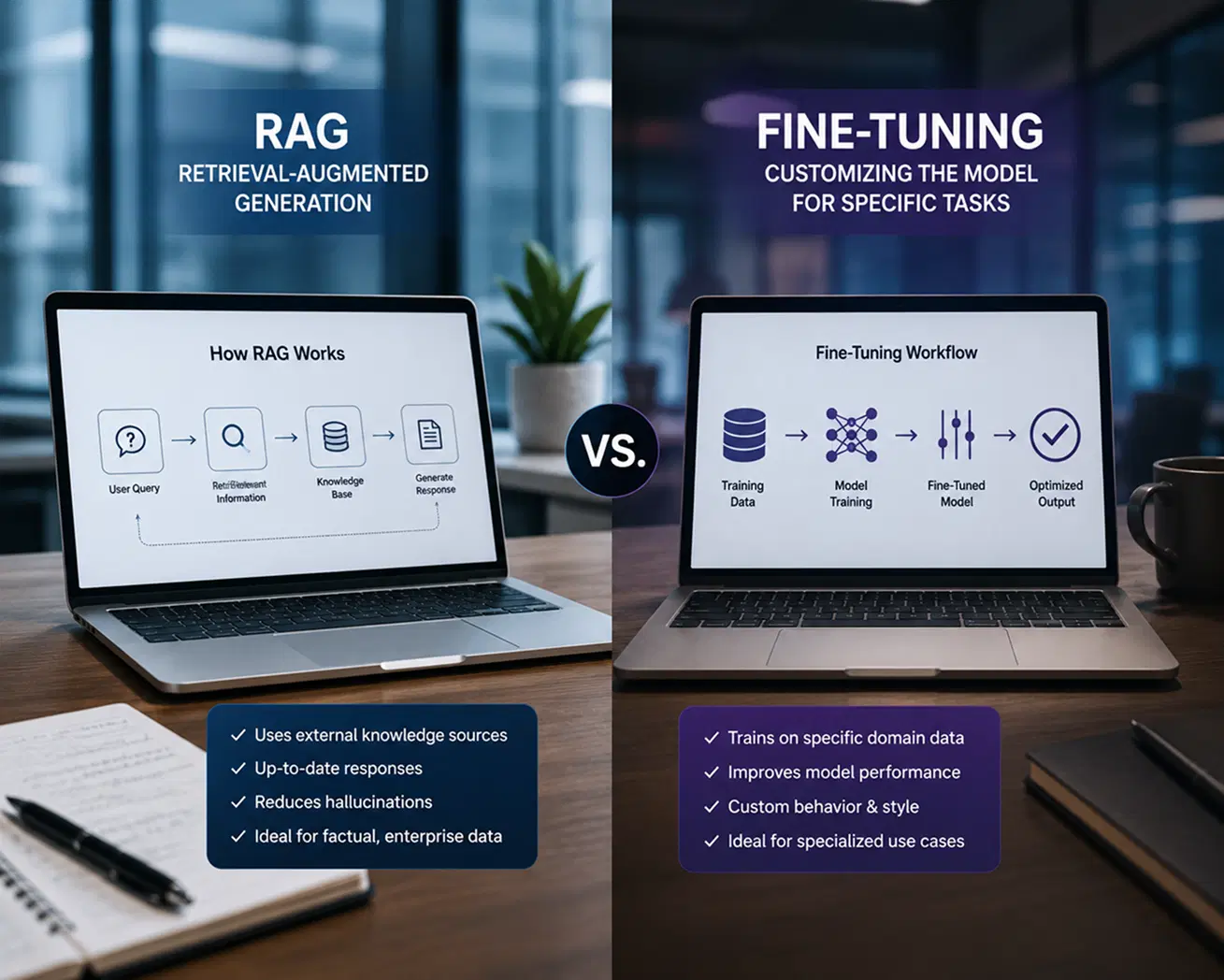
The Enterprise Dilemma
When engineering generative software, companies face a crucial architectural choice: How do we customize the model with our proprietary data? The two dominant techniques are Retrieval-Augmented Generation (RAG) and Fine-Tuning. Selecting the wrong path can lead to inaccurate answers, high token costs, or wasted engineering effort. Here is how they compare.
1. Retrieval-Augmented Generation (RAG)
RAG acts like an open-book exam. When a query is received, a search is run across database records to find relevant documents. These documents are dynamically appended to the model prompt as reference material, ensuring the response is based on factual sources.
- Pros: Highly accurate, updates instantly when source files change, low initial development cost, and clear audit trail.
- Cons: Bound by the context window limits of the model, and queries consume more tokens, increasing recurring billing.
2. Model Fine-Tuning
Fine-tuning is like studying for weeks before an exam. You feed the training dataset directly into the neural network to adjust the weight matrices. This changes the model's internal vocabulary, response structure, and domain-specific style.
- Pros: Customizes formatting, reduces response latency, and queries use fewer tokens because context doesn't need to be sent each time.
- Cons: High GPU training costs, hard to update with new facts, and models are prone to hallucinating missing data.
3. Comparison Matrix
| Parameter | RAG Pipeline | Fine-Tuning |
|---|---|---|
| Primary Goal | Factual Retrieval | Style, Tone & Format |
| Data Dynamic Updates | Real-time | Requires retraining run |
| GPU Overhead | None (Inference only) | High (Training + Hosting) |
4. The Hybrid Path
Modern enterprises rarely rely on one method. The most scalable architecture is hybrid: a fine-tuned, lightweight open-source model (e.g. Llama-3-8B) optimized for structural tone and response speed, which queries a vector-based RAG pipeline to retrieve factual details dynamically.